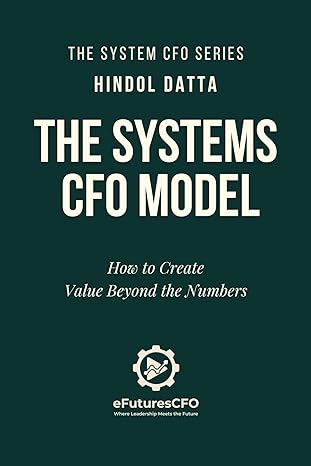
The Systems CFO Model
The financial statements tell you what happened. They do not tell you why. They do not tell you which customers are quietly eroding your margins, which operational bottlenecks are compressing your growth, or why your most carefully constructed strategic initiatives keep delivering less than they promised. By the time those answers appear in the numbers, the damage is already compounding.
The Systems CFO Model is built around a single, field-tested conviction: the finance leaders who create lasting enterprise value are not the ones with the most sophisticated models. They are the ones who can see the system underneath the numbers — the invisible architecture of incentives, information flows, capital decisions, and organizational behavior that determines whether a business builds value or slowly consumes it.
Get Chapter 1 free — plus join the Systems CFO newsletter for weekly frameworks.
What's Inside
A deep dive into the systems CFO methodology
<div class=”book-summary-content”>
<div class=”chapter-list”>
<!– Chapter 1 –>
<div class=”chapter-item”>
<div class=”chapter-header”>
<span class=”chapter-number”>Chapter 1</span>
<span class=”chapter-title”>The CFO as Value Architect</span>
</div>
<p class=”chapter-desc”>The CFO’s real job is designing value-creating systems — aligning incentives, structuring information flow, and governing decision rights across the organization.</p>
</div>
<!– Chapter 2 –>
<div class=”chapter-item”>
<div class=”chapter-header”>
<span class=”chapter-number”>Chapter 2</span>
<span class=”chapter-title”>Enterprise Value: Narrative, Numbers, and Time</span>
</div>
<p class=”chapter-desc”>Enterprise value is constrained storytelling: cash flows, growth, and risk are the only three variables that matter; reducing risk creates value as powerfully as increasing cash flow.</p>
</div>
<!– Chapter 3 –>
<div class=”chapter-item”>
<div class=”chapter-header”>
<span class=”chapter-number”>Chapter 3</span>
<span class=”chapter-title”>Market Structure and Competitive Moats</span>
</div>
<p class=”chapter-desc”>Industry structure determines who captures value; CFOs must reshape Porter’s Five Forces, engineer cost advantages, and build network effects to sustain competitive moats.</p>
</div>
<!– Chapter 4 –>
<div class=”chapter-item”>
<div class=”chapter-header”>
<span class=”chapter-number”>Chapter 4</span>
<span class=”chapter-title”>Real Options, Optionality, and Decision Trees</span>
</div>
<p class=”chapter-desc”>Traditional NPV systematically undervalues growth by ignoring optionality; treat the company as a portfolio of staged options where uncertainty can increase strategic value.</p>
</div>
<!– Chapter 5 –>
<div class=”chapter-item”>
<div class=”chapter-header”>
<span class=”chapter-number”>Chapter 5</span>
<span class=”chapter-title”>Unit Economics and Business Model Design</span>
</div>
<p class=”chapter-desc”>CAC, LTV, and payback period are the genetic code of any business — weak unit economics trap companies in perpetual fundraising regardless of revenue growth.</p>
</div>
<!– Chapter 6 –>
<div class=”chapter-item”>
<div class=”chapter-header”>
<span class=”chapter-number”>Chapter 6</span>
<span class=”chapter-title”>Pricing Power and the Psychology of Value</span>
</div>
<p class=”chapter-desc”>Price is a signal, not just a number; value-based pricing, behavioral psychology, and willingness-to-pay segmentation unlock dramatically more value from the same product.</p>
</div>
<!– Chapter 7 –>
<div class=”chapter-item”>
<div class=”chapter-header”>
<span class=”chapter-number”>Chapter 7</span>
<span class=”chapter-title”>Scaling, Systems, and the Hidden Laws of Growth</span>
</div>
<p class=”chapter-desc”>Companies scale like organisms — coordination costs eventually outpace output; CFOs must fight bureaucratic entropy through constraint management and adaptive system design.</p>
</div>
<!– Chapter 8 –>
<div class=”chapter-item”>
<div class=”chapter-header”>
<span class=”chapter-number”>Chapter 8</span>
<span class=”chapter-title”>Working Capital as Flow Physics</span>
</div>
<p class=”chapter-desc”>Profitable companies die from cash starvation; mastering the cash conversion cycle by attacking inventory, receivables, and payables can make growth self-financing.</p>
</div>
<!– Chapter 9 –>
<div class=”chapter-item”>
<div class=”chapter-header”>
<span class=”chapter-number”>Chapter 9</span>
<span class=”chapter-title”>Supply Chains, Networks, and Fragility</span>
</div>
<p class=”chapter-desc”>Supply chains are complex adaptive systems with power-law disruption risk; CFOs must design for antifragility, not just efficiency, by understanding network topology and cascade failure.</p>
</div>
<!– Chapter 10 –>
<div class=”chapter-item”>
<div class=”chapter-header”>
<span class=”chapter-number”>Chapter 10</span>
<span class=”chapter-title”>Capital Allocation as Leadership</span>
</div>
<p class=”chapter-desc”>Capital allocation is leadership’s primary job — every dollar is a vote for a future; opportunity cost, portfolio thinking, and Kelly-criterion bet sizing separate great allocators from the rest.</p>
</div>
<!– Chapter 11 –>
<div class=”chapter-item”>
<div class=”chapter-header”>
<span class=”chapter-number”>Chapter 11</span>
<span class=”chapter-title”>Corporate Risk, Black Swans, and Antifragility</span>
</div>
<p class=”chapter-desc”>Real risks follow fat-tailed power laws, not normal distributions; the only metric that matters is probability of ruin, and CFOs must build organizations that gain from disorder.</p>
</div>
<!– Chapter 12 –>
<div class=”chapter-item”>
<div class=”chapter-header”>
<span class=”chapter-number”>Chapter 12</span>
<span class=”chapter-title”>Inorganic Growth and Integration Economics</span>
</div>
<p class=”chapter-desc”>Sixty to eighty percent of acquisitions destroy value because integration — not deal terms — determines outcomes; companies are complex adaptive systems, not LEGO blocks.</p>
</div>
<!– Chapter 13 –>
<div class=”chapter-item”>
<div class=”chapter-header”>
<span class=”chapter-number”>Chapter 13</span>
<span class=”chapter-title”>High-Performance Finance Organizations</span>
</div>
<p class=”chapter-desc”>High-performing teams emerge from system design, not talent alone; autonomy, mastery, and purpose outperform money and fear as motivators in knowledge-work environments.</p>
</div>
<!– Chapter 14 –>
<div class=”chapter-item”>
<div class=”chapter-header”>
<span class=”chapter-number”>Chapter 14</span>
<span class=”chapter-title”>Technology, Systems, and the Digitally Enabled CFO</span>
</div>
<p class=”chapter-desc”>Technology is process logic made durable; CFOs must be architecturally literate — working top-down from strategy through process and data before selecting any platform.</p>
</div>
<!– Chapter 15 –>
<div class=”chapter-item”>
<div class=”chapter-header”>
<span class=”chapter-number”>Chapter 15</span>
<span class=”chapter-title”>CFO as Fiduciary, Governance, and Long-Term Stewardship</span>
</div>
<p class=”chapter-desc”>The CFO is the keystone of corporate governance — uniquely positioned at the intersection of ownership and control, responsible for stewardship that outlasts any individual tenure.</p>
</div>
<!– Chapter 16 –>
<div class=”chapter-item”>
<div class=”chapter-header”>
<span class=”chapter-number”>Chapter 16</span>
<span class=”chapter-title”>Maximizing Enterprise Value with System-Level Thinking</span>
</div>
<p class=”chapter-desc”>Financial results are lagging indicators; the systems CFO sees feedback loops, detects system degradation before it appears in earnings, and builds compounding through integrated design.</p>
</div>
</div>
</div>
The CFO's real job is designing value-creating systems — aligning incentives, structuring information flow, and governing decision rights across the organization.
Enterprise value is constrained storytelling: cash flows, growth, and risk are the only three variables that matter; reducing risk creates value as powerfully as increasing cash flow.
Industry structure determines who captures value; CFOs must reshape Porter's Five Forces, engineer cost advantages, and build network effects to sustain competitive moats.
Traditional NPV systematically undervalues growth by ignoring optionality; treat the company as a portfolio of staged options where uncertainty can increase strategic value.
CAC, LTV, and payback period are the genetic code of any business — weak unit economics trap companies in perpetual fundraising regardless of revenue growth.
Price is a signal, not just a number; value-based pricing, behavioral psychology, and willingness-to-pay segmentation unlock dramatically more value from the same product.
Companies scale like organisms — coordination costs eventually outpace output; CFOs must fight bureaucratic entropy through constraint management and adaptive system design.
Profitable companies die from cash starvation; mastering the cash conversion cycle by attacking inventory, receivables, and payables can make growth self-financing.
Supply chains are complex adaptive systems with power-law disruption risk; CFOs must design for antifragility, not just efficiency, by understanding network topology and cascade failure.
Capital allocation is leadership's primary job — every dollar is a vote for a future; opportunity cost, portfolio thinking, and Kelly-criterion bet sizing separate great allocators from the rest.
Real risks follow fat-tailed power laws, not normal distributions; the only metric that matters is probability of ruin, and CFOs must build organizations that gain from disorder.
Sixty to eighty percent of acquisitions destroy value because integration — not deal terms — determines outcomes; companies are complex adaptive systems, not LEGO blocks.
High-performing teams emerge from system design, not talent alone; autonomy, mastery, and purpose outperform money and fear as motivators in knowledge-work environments.
Technology is process logic made durable; CFOs must be architecturally literate — working top-down from strategy through process and data before selecting any platform.
The CFO is the keystone of corporate governance — uniquely positioned at the intersection of ownership and control, responsible for stewardship that outlasts any individual tenure.
Financial results are lagging indicators; the systems CFO sees feedback loops, detects system degradation before it appears in earnings, and builds compounding through integrated design.

The System CFO Series
Ten books. One framework. A new language for finance leadership.