BEYOND LINEAR FINANCE
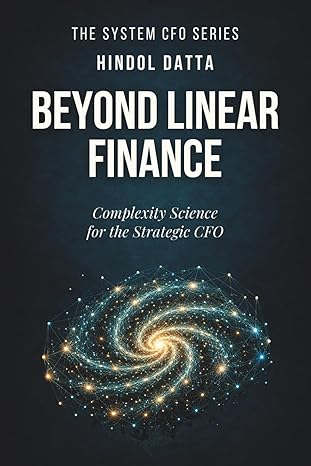
Beyond Linear Finance is Hindol Datta’s argument that the financial frameworks most CFOs were trained on — discounted cash flow, linear forecasting, mechanistic cost-benefit analysis — were built for a world of stable, predictable, Newtonian systems that no longer exist. Drawing on more than twenty-five years of operating experience across gaming, cybersecurity, SaaS, edtech, manufacturing, digital marketing, and medical devices, Datta makes the case that modern organizations are complex adaptive systems whose most important properties — culture, innovation capacity, resilience, strategic positioning — emerge from interactions rather than reside in any single component. Traditional finance tools systematically miss these dynamics, which is why elegant models keep being ambushed by reality
Get Chapter 1 free — plus join the Systems CFO newsletter for weekly frameworks.
Distinguishes complex from merely complicated systems and explains why linear financial models consistently fail to capture how real organizations behave.
Applies thermodynamics and information theory to show why organizations drift toward disorder and why efficiency-driven slack removal destroys adaptive capacity.
Argues the org chart is fiction; network science reveals the real structures — density, hubs, small-world properties — that determine organizational capability.
Explains why culture, innovation, and performance arise from interactions rather than components, and why CFOs must cultivate conditions rather than command outcomes.
Shows how order emerges without central control through autonomy, information, alignment, and feedback, and introduces phase transitions and the edge-of-chaos regime.
Covers the exploration-exploitation trade-off, fitness landscapes, and why organizations that excel at familiar challenges become fragile when novel disruptions arrive.
Critiques discounted cash flow and introduces real options, scenario planning, and a multi-dimensional valuation framework incorporating option, network, and learning value.
Examines network effects, positive feedback loops, threshold effects, and winner-take-all dynamics that create disproportionate outcomes linear capital allocation models cannot handle.
Explains how increasing returns, sunk costs, coordination effects, and expertise asymmetries lock organizations into trajectories, creating traps and suboptimal equilibria.
Uses Herbert Simon's near-decomposability principle and Conway's Law to show how architectural choices govern an organization's capacity to evolve and scale.
Applies Geoffrey West's research to explain why cities persist while companies die, and how sublinear and superlinear scaling shape organizational design.
Introduces Ashby's law — only variety absorbs variety — to explain why one-size-fits-all management fails in genuinely complex environments.
Distinguishes fixed-point, limit-cycle, and strange attractors, showing why organizational states persist and how CFOs can reshape the stability landscape.
Separates risk, uncertainty, and ambiguity; introduces the Cynefin framework and probabilistic thinking for matching decision methods to problem types.
Integrates Goldratt's Theory of Constraints, behavioral economics, and Buchanan's public choice theory into a unified lens on organizational action.
Applies variation, selection, and retention to organizations, covering the innovator's dilemma, technology adoption, and resilience engineering principles.
Translates complexity frameworks into daily practice through Monte Carlo forecasting, portfolio thinking, triangulation, and rapid learning cycles for the finance function.
Key Frameworks You'll Learn
Practical tools you can apply immediately
Complexity Diagnostics
A toolkit to distinguish complex from complicated systems in your organization.
Chapter 1Entropy Mapping
Tools to measure and manage organizational disorder and energy.
Chapter 2Topology of Value
Mapping network density and hubs beyond the traditional org chart.
Chapter 3Edge-of-Chaos Regime
Framework for navigating phase transitions and spontaneous order.
Chapter 5Multi-Dimensional Valuation
Moving beyond NPV to incorporate option, network, and learning value.
Chapter 7Scaling Laws Matrix
Applying sublinear and superlinear scaling to organizational design.
Chapter 11About the Author

The System CFO Series
Ten books. One framework. A new language for finance leadership.